Helen Szamuely has a great post reacting to the US election result at EURef here.
I had a phone message today from a liberal friend asking innocently what I thought of the US election result. I said very simply in eight words -with a :-)- that I thought the Republicans got what they deserved- believing as I do in the democratic process and that Republicans have failed to show the necessary leadership.
On the other hand, I don't for a minute trust the Democrats. Why? Because there is a reason why the Republicans behaved so badly, and that is to compensate themselves for having to face daily a Democrat party that always knows better but is never good enough in a reasonable discourse to suggest in what way that might be (we know they want to quit Iraq but still can't say so publicly except by insinuation), which posits spurious friends and talks down actual enemies. It's that deliberate lack of seriousness that has undermined the whole integrity of US politics. It's been one long fillibuster, and its effectiveness in lulling the Right has been taken as evidence of political know-how. In the sense that the political vacuum has made idle hands of Republicans, the Devil has made use of them. And the judgement is just.
Friday, November 10, 2006

Thursday, November 09, 2006
In the wake of the US election (yes, I do mean wake), we are moved to ask the big questions, such as "Can Borat Save Western Civilization?"
Well, no. But still.
And actually (a few minutes post posting here), according to the BBC Borat "has a series of real life encounters with unsuspecting Americans in which he makes the most outrageous, sexist, racist, anti-Semitic and homophobic comments."
So maybe. (of course, the best joke, in the best tradition of jokes, at least concerning the anti-Semitic part, is that the comedian is Jewish- I think Aunty meant to say anti-Jewish. Bless.)
Wednesday, November 08, 2006
And lo, the blind have seen, and the US has voted Democrat.
(coincidentally co-front page stories at BBC views news online)
I don't know about the US population, but I certainly feel galvanised.
Sunday, November 05, 2006
Steering the Scylla and Charibdis
Orson Scott Card has a brilliant essay at The Ornery American; some of the best, simplest explanations of why, in accordance with my views as it happens, G W Bush stands out as a wise and just leader for the times we live in.
Here online there is a vast amount of information available about US politics; it's all up front and out there. I was quite taken with the Ornery statements of values. A country whose interpretation of the ordinary is as a stand alone free thinker is quite mesmerising.
Scott-Card was the co-author of a fine novel I read when a young teen: the Abyss, which was, unusually, a fine novel based on a film (though the film was unreleased at the time of publishing). It was quite gritty and real from my point of view then, and unusual too in its concern for characterisation in a Sci Fi genre. He seemed to have a certain integrity; he still does.
I love the way he defends the "War on Terror" terminology used by Bush:
"it is precisely those people -- the common people of the Muslim world, most of whom hate us (or claim to hate us, when asked by pollsters in police states) -- whom we must treat as if they were not our enemies."
He applauds the deliberate vagueness of the term.
I personally think a "War on Islamofascism" would be as good, if not better, but then that is one of the formulations Bush himself has recently used.
I also love his analysis of the Bush strategy for the Middle East. This idea of confronting your enemies at a time and place of your choosing. Of carefully selecting which ones to pick off and which to play against each other. He points out that the right decisions have already been made. It is a bold essay, whose botom line is terrifyingly simple:
"It's an astonishingly twisted game -- and as long as we don't do anything really, really stupid, like withdrawing from Iraq, all these various treacheries will inevitably lead to the fall of the tyrants in Iran, and therefore in Syria, and therefore the taming of Hezbollah in Lebanon."
Wow. Like standing on the dotted line in a motorway full of careering traffic.
Wednesday, November 01, 2006
Speaking of funny...
We don't need any film comedies when we've got John Kerry. I believe in the adage that "it's funny because it's true". When I laugh at John Kerry, it's not because he says what's true, but because he's truly as stupid as he seems. Hilarious; and even though it's deadly serious, I had to laugh on reading Victor Davis Hanson's list of problems with the Boston Brahmin.
Beeb Leads Sense of Humour Rebellion
Someone on some blog mentioned Borat- you know, cultural learnings from the USA- and I couldn't resist Googling to find out what the reviewers were saying.
The first review I came across was the BBC's, and a more facile, humourless take-down of a comedy film would be hard to imagine. The so called writer tries to imitate the Borat style, and indicates by his feeble effort the reverse of his criticism that Borat's comedy is cheap: "not hard joke to do, as we proves"- not.
Then I went, as is my wont, to the Rotten Tomatoes website, and found that Borat got a 91% rating from the rest of the reviews. That's some very fresh tomatoes. The consensus was "offensive in the funniest possible way".
I also noted the company the BBC were keeping. There was the classic comment that "It's a sad state of our own nation that people still find sexist and racist humour so amusing" review here
It's adorable, isn't it? Society just hasn't evolved enough, we still laugh at basic things like the human condition. Not the BBC though.
This morning, by the way, I was talking to an artist. Yes, it happens. In the course of her conversation she was telling me about her art. Photographs, taken in specific locations, superimposed one upon the other to create an otherworldy take on our own world. It would be easy to make a mess, but her compositions were beautiful because so cleverly balanced and ordered to destabilise and harmonise simultaneously. It looked easy but it certainly wasn't.
BTW, reviews of the BBC review granted our brave BBC boy a whole 13% rating, with choice comments including "that review sounded like it was written by a ten year old."
Saturday, October 28, 2006
 ?
?
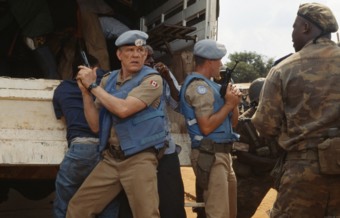
Colonial rights and wrongs.
EURef recently reported on the latest in the attempts of Rwanda to come to terms with the genocide which took place over a decade ago, by blaming France.
Well, that could be all it is, but this report indicates some telling actions on the part of French troops, including how "French forces lured Tutsis from hideouts in the hills to village centers where they were killed."
That detail comes right at the end of the article, and one senses that, where the media have covered the latest allegations, scepticism has been built in to the reporting. The BBC's article, for example, takes a long time before moving to specifics.
What is not in doubt is that France trained the Hutu military which was active in the slaughter, up to the time of the slaughter (after it there was no need).
Beyond that, the problem is that there are strong political motives to blame France, exemplified here, and there is a history of false claims against (fmr) colonial powers such as this one where the Brits were accused of mass rape of Kenyan women.
The unequal battle and sometime absurdity of African claims against (fmr) colonial powers is comically evident in the understated BBC presentation:
"A forensic examination of police records in Kenya has concluded that all known reports of alleged rape by British army soldiers are forgeries.
This is a major development in the rape cases"
Er, what rape cases?
Still, despite this there is a moral responsibility I would like to highlight, and by that standard the French are well and truly guilty. The moral standards in Africa may be terribly schizophrenic, but if a sane person, for the sake of retaining and enhancing their status in society, facilitated and encouraged a temporarily insane and generally unstable person's desire to kill people, wouldn't they actually be morally guiltier than the mental person?
It may sound like a thin argument, but in the absence of reliable evidence there is much sense in saying that France was responsible for the genocide, an event of remarkable superfluity in Africa's grim trajectory.
The great film Hotel Rwanda begins with a radio broadcast indicating President Clinton's preoccupation with Bosnia, and later another broadcast describes the refusal of the State department to define events as "genocide"- a definition upon which intervention was contingent.
But the part which struck me most was the part where hero of the story, Rwandan hotel manager Paul Rusesabagina, calls his Sabena company boss in Belgium as a last throw of the dice when facing Hutu troops bent on emptying his hotel of its Tutsi refugees. The exchange went thus:
Sabena boss: "Who can I call to stop this?"
Rusesabagina: "The French, they supply the Hutu army".
Sabena boss: "I'll call you right back"
The Sabena boss (the film explains) contacts the French President's office. The hotel was spared. QED.
Heavy handed film maker's moralising for the audience, or a summary of action that took place?
The film is accurate and precise about British and US actions at the time, as well as UN and Belgian actions. I wouldn't bet against it over the French involvement. I never bought the army rape allegations from Kenya, though. Some things chime with their contexts, and the French involvemnt in Rwandan genocide is one of them. When you look at their behaviour in the Ivory Coast, a pattern of callousness seems to emerge quite alien from the British amnesia which tends to be our predominant vice.
Wednesday, October 25, 2006
Well, what d'you know? Sudan's about to annex Chad.
Despite media moral equivalence between Sudanese rebels and Sudan's military/militias, and despite moral equivalence between Sudan and Chad
- countries of wildly differing military strength- it was always blatantly obvious who the regional power was, and how aggressive (scroll half way down) were its intents.
We will live to regret not being tougher on Sudan. In the modern context occupation of territory is key (think how difficult it is for the US in Iraq when they occupy only dots on a map, or Israel when they try to take out Hezbullah), and the Islamists are getting plenty of that all across North and East Africa.
It's funny but I'm getting this pain in my back right where my White Man's Burden used to be.
Sunday, October 22, 2006
Non-random gleanings
By the way, I wonder if any helpful reader would care to provide a working definition of "unsustainable."- Mark Steyn on the 300th million American
"what if the history books of the future are written in Arabic or Farsi? 2000 years ago they were in Latin"- a commenter on Mark Steyn's doomsday scenario for Europe and elsewhere, reviewed here.
"You start assembling a list of names...you deepen the roots...it radiates out... eventually you try to reach as much of the universe as you can"- Lawrence Wright describing his authorship of The Looming Tower, the story of Al Qaeda's rise to lethality. Pajamas interview here (audio). New Yorker interview (text) here.
ps. for those concerned, I haven't given up pointing out BBC bias; they're pointing it out themselves right enough. Just recharging the batteries on that front.
Friday, October 20, 2006
Oh Dear.
I watched the whole of the video available of Paul Belien's interview with Pamela of Atlas Shrugs, and the cumulative effect was quite terrible. Belien is the founder of the website The Brussels Journal, and a man who feels acutely the times he lives in.
As often a statistic he mentioned stood out and rammed the message home. When talking about muslim violence in Paris he said that it should be a matter for the French army. Then he stated that the French army is already 15% muslim, so that would be problematic.
If true, that's a shocking statistic which calls into question all the cosy last resorts scenarios with which people put off making hard decisions about immigration and multiculturalism. If not true, it's a lot closer to being "fake but true" than the majority of faux stories in the MSM. Facts are the most precious commodity in the modern world, but I'd rather this weren't one of them.
Tuesday, October 17, 2006

The funny thing about this awful logo is the fact that when the accents are reproduced as they are in French and German- with the acute accent and the umlaud- they produce a strangulated sound something like "tuurgethair". In other words it's Frenglisch.
Btw, Richard North has been producing some cracking stuff recently; like this one for instance. Reality can be a bit hard, but like a sharp breeze on a cold morning the lungs can really fill with it. If I hadn't forotten username and password by now I would be commenting :-).
Look too at Michelle Malkin's view of EU ambitions to regulate moving pictures on the internet. I'm not surprised about that, given that progress could just be a little too fast for certain sluggish continental cousins.
Sunday, October 15, 2006
Is it just me, or does ramadan seem to come earlier every year? (via Atlas)
Must be my "complete lack of awareness and sensitivity."
Thay should watch Chariots of Fire to get into the spirit of things.
Tuesday, October 10, 2006
Rushdie on the veil:
"I think the battle against the veil has been a long and continuing battle against the limitation of women"
Report here (via Oliver Kamm)
It is, of course, more than that, but it certainly is that.
On this last point, just came across Adloyada's post on the subject. She basically opposes the opponents of the veil. The point she misses while she is comparing the veil to all manner of cultural artefacts accepted in the UK already, is the orchestration point I think is most important to what I said below. Islam uses such tools of conformity to enforce the differentiation of themselves and unbelievers. Steyn pointed out today that some non-muslim women adopt the veil when entering especially Muslim areas of Paris just to avoid abuse. That's the kind of thing I'm talking about, though the most important conformity they are trying to instill is internal, so as to present a powerful and united front. Think of it as a perpetual mass demonstration against western values and you'll be close to what they have in mind.
Sunday, October 08, 2006
The Veil
Bad
Point One
A while back, while I was shifting locations, I stayed for a period with a German girl who needed a housemate temporarily.
Being a friendly sort of person I tried to have a few conversations with her to make the atmosphere more homely. She obviously felt this somehow encroached her "personal space"- or at least it seemed so when she appeared one day with a T-shirt boldly emblazoned with the words "YOU DON'T KNOW ME" on it. Well, she apparently wore it all day so it wasn't exactly a private message, but somehow the message of the clothing got to me in a way that a simple conversation about keeping onesself to onesself never could have. It intrigued me that someone would have purchased clothing with a message so much to the front and centre- but of course many people do that; just not me.
The point of this is that clothing sends messages, and it can be used to intimidate. I didn't particularly have strong feelings either way regarding her, but I certainly redoubled my efforts to find a more permanent location to live- and I imagine she felt reasonably satisfied with that.
I think it's a big mistake to underestimate the political and social significance of dress.
Point Two
Reading this article on the politics of dress in Egypt, I came across this sentence:
"it is very important to note that the state deliberately promotes Western dress over any other form of dress"
Recalling Ahmadinejad's tieless appearance at the UN recently, I found this article talking about an apparent resurgence of the tie in Iran- in 2002, prior to the latest president's reign.
Even then, according to a Government source then "The 1979 Islamic revolution was mostly a cultural revolution. The tie is a symbol of the West and we don't want to be followers of the West. We want to keep our own cultural identity"
It was also said that in the times after the revolution "Any man with a tie risked being condemned as pro-Western and could have faced beatings or detention."
Interesting. I have always associated assigning significance to symbols with primitivism, notwithstanding their political application. I don't regard ties as political; I rather take the Beau Brummel approach to them, since they stylishly create a symmetry in the upper half of a man- women have a pleasing (very) natural symmetry in that regard.
Point Three
If we look at the intended symbolism and purpose behind veiling- both partial and full- there is certainly something going on. That something is the fetishisation of female chastity.
People say that women in Christianity have traditionally covered up- and of course Nuns do so as a mark of a calling. Whether one agrees with that or not, the covering of the head advocated in the Bible is a question of authority, not of chastity. Dressing modestly may be what some Muslim women practise, but the hijab and niqab are about advertising chastity. In societies where such strict standards of clothing apply, equally stringent punishments for unchasteness accompany them. Marc at USS Neverdock flagged up this video of the stoning of women (warning: very disturbing material). Notably, both women stoned are fully clothed from head to toe at the beginning- the clothes are ripped off them by the impact of the stones. Watching it one word was all I could find; otherwise I was speechless. Savages.
Point Four (summary)
Dress has real historical significance, and this has been regulated. From the roundheads to the blackshirts, to the burka, dress has been used to instill uniformity and fear. The use of women in this respect is particularly abhorrent, but in keeping with the politicisation of civilians which seems to underpin all Islamic struggles, or "Jihad" as they are also known.
The hijab and niqab are cultural artefacts which were not intrinsic or of unwavering importance to Islam and have their parallels all over the world. However we live in a globalised society and they are now being imposed as part of a worldwide jihad. The personal choice of women has very little to do with it.
This BBC article is a good example of an inadequate approach to Islamic dress- dealing only with the present, not with historical trends, and analysing only the religious aspects rather than the political level where it really gets interesting. We don't need to know much about the interpretation of Koranic texts- what's far more relevant to us is the political uses of the dress code. It's also noticeable that the attempt to make a distinction between hijab and niqab is a bit strained.
Just now all kinds of symbol are becoming controversial, and pressure builds to have them removed. The latest publicised case is that of Fiona Bruce's cross. I'm generally laissez faire on such things, but when there is a degree of orchestration and a political message behind the clothing symbols, it's appropriate to make an orchestrated response. The hijab might stay (maybe)- if it means wearing a headscarf a la Benazir Bhutto, and here the crucial aspect of personal choice of style of dress is foremost- but not in workplaces unless of a specifically religous character. It would be strange to ban something akin to many traditional European garments, and unworkable. The niqab must go, unequivocally. Pick and mix must always apply to public dress, otherwise totalitarianism can rise up through its medium. Pick and mix sometimes has to be sustained by the intervention of the law, and so it should be in this case.
Better (were she not actually conceding ground to Islamofascists by dressing this way- she actually appeared sometimes without covering at all, but this roused seething from her growing Islamist critics)
Addendum: Marc points out an interesting article on the hijab in Morocco.
Manolo offers the light relief.
Tuesday, October 03, 2006
Ahh, I think it may be time for a Dennis Boyles season-
"Remember Spitting Image, the British TV show starring insane puppets who looked like caricatures of Margaret Thatcher and Ronald Reagan? Nowadays, it’s on BBC-2, where it’s called Newsnight. The funniest puppet by far is the “Jeremy Paxman” one. He looks exactly like a pompous, self-righteous, self-important windbag with fabulous hair. But really the whole crew is hilarious, pretending to do news by speaking loudly and interrupting, when everyone knows it’s that typically British parody stuff, the kind of thing they call “barking mad” because only dogs take it seriously"
Saturday, September 30, 2006
Legalism
It's a bit of a plague really; in many ways the UK and other western countries seem more lawless than previously they were. On the other hand we seem more than ever mindful about arbitrary legal requirements.
It would be strange, in this context, not to mention Richard North. After running up against his local constabulary on several occasions, confronting the press over Qanagate, and his fellow bloggers over their shallowness, he seems to have attracted the ire of the Daily telegraph over borrowing from their photo archive. Actually the second point may have some relevance to the latter point, as the Telegraph were thoroughly narked not to say rattled when their Qana coverage came under fire.
On the subject of photos, I recently decided to include some on this blog, for the simple reason that I realised how easy they were to load and had decided a while back that there was no significant reason to spurn them any longer. I had originally imposed a purdah on photos on my blog(s) because I felt that I needed just to write, without the distraction and easy option of photos. This self-imposed discipline seemed reasonable for a while but became defunct a while back- hence I explored the pictorial option.
Now, it would seem, just as I get into the picture biz, the biz is coming under scrutiny.
To me, in a world where the rapine media exists, pictures abound and visual, oral and written communication fuse seamlessly, pictures are ten a'penny and effectively worthless. The Telegraph may huff and puff but they are just fantastically out of touch- every Tom Dick or Harry has a digital camera and the capacity to bring forward pictures without training. This is becoming more and more a reality everywhere, not just in the West. It doesn't even need a digital, either. I was really proud of what I achieved in Kenya with disposables. I have other photos from time spent in Spain, and I aim one day to get out and about in my favourite Prague locations to get some really special ones- all will sooner or later be freely available on the web.
On the other hand such is the legalism of the western mind, pictorial evidence is more and more important to affirm the valdity of any truth claim. Why, for example, did the US DoD see fit to publish this photo of "detainee salad"? (a picture used by Claudia Rosett to illustrate a recent visit to Guantanmo):

When Mark Steyn, another participant in the media Guan'mo junket, mentioned the L-z-boy chairs of interrogational horror of detainees there, I took the opportunity of a link to have a look at some examples. Here is one, much nicer than what I'm sitting on right now:

Of course this need for pictures is one which the press have long pandered to. I remember the Telegraph introducing colour photos. Think about the glossy magazine approach which prolonged the interest of newspaper readers in the advancing consumerism of the 80's and 90's. Now they have a smorgasbord of photography to offer, and the prevalence of photography is proving difficult for them, since where we are saturated with photographs on the net they are having difficulty at doing something- anything- better than the net.
I have to admit I find the legal wranglings over Guanatanamo difficult to follow- it's not my legal system, for one thing. That's largely unimportant, however, as it would be the same in the British court system. It's interesting that alongside the chicanery of legal principle we find the need to be so pictorial in our approach- think about the immensely visual approach to war crimes, to bombings, to torture. In an age of shifty words we rely more and more on photos. To me they are stimulus, on occasion; best when witty and ironic, when they cast a shade of humour across some reasoned thoughts. I imposed my photo purdah so I wouldn't lose sight of that. It seems the Telegraph lost their reason with their humour- and their readership.
Now wouldn't it be ironic if I had to remove one of these photos- hardly likely to happen, I think.
Tuesday, September 26, 2006
The Time Machine, again
Claudia Rosett has done us a service and reminded us exactly what was said about Bill Clinton's strike on Afghanistan in August '98.
I couldn't remember because I only know what was being said in Kenya at that time- and they basically felt that Clinton had no moral authority to be lobbing missiles around.
Take time to enter The Time Machine (really, do. The echoes, almost poignant, are uncanny)
All agin' you were they Bill, poor lamb.
Monday, September 25, 2006
 the very pick me uppish Drinking from Home seems to have done as I have today and listened to Gordon Brown's speech, lovingly provided by the BBC. Rather more carefully though.
Sunday, September 24, 2006

Religious Disrespect.
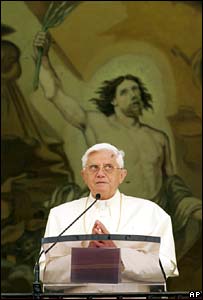
Well I know infallibility has a specialised meaning, and even then I don't have much time for it, but the BBC's David Willey seems to be getting a somewhat unhealthy kick out of the Pope's current issues.
According to said Willey in this BBC article:
"The Pope is eating humble pie before the world."
Which is a slightly odd thing to say when reporting that the Pontiff "did not retract words uttered during his six-day trip to Bavaria as demanded by his Muslim critics"
But to bang a drum for the papists for a moment, isn't Willey being a bit rude, nay, childishly cocky, about the most senior figure in the world's foremost church? Not sure if His Highness St Koffi of Annan would get the same treatment.
And bye the bye, I'd just note that the BBC have changed subtly their representation of that quote. Now it's "he quoted medieval Byzantine emperor Manuel II Paleologos criticising some teachings of the Prophet Mohammed as "evil and inhuman"."
I think it could be termed nuancing the stable door.
FWIW, I agree with fmr Arch-Bish Carey's view of Benedict's speech, though not the Times' sensationalism. And, would it not be a mark of respect for Christianity for the BBC to report it too? I see nothing about it anywhere on the Beeb.
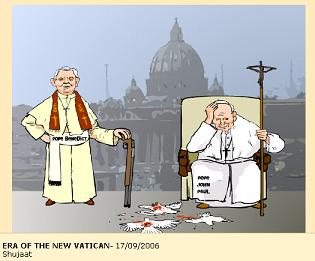
ps, I also notice this from Melanie Phillips. As always invaluable.

