Gorilling news
Well, I am very pleased to hear that Gorilla numbers are higher than they've been saying for the last 20 years.
One personal observation I made while I lived for a spell in Africa was how much better at living alongside nature Africans (Kenyans specifically) were than they were generally perceived to be. Flora of all kinds and forna of all except snakes were pretty much welcome. They don't like things eating their cows or their crops, but outside of direct provocation, Africans are pretty harmless to animals. One reason why Africa is less developed is that Africans like widening their eyes to nature, and going with its flow. But that's by the bye, I guess.
Showing posts with label Africa. Show all posts
Showing posts with label Africa. Show all posts
Wednesday, August 06, 2008

Monday, July 21, 2008
„because there is no-one who has a monopoly of patriotism, there is no one who can claim that he has a monopoly of the sovereign will of the people... I hope that all of us who are signatories to this memorandum always must bear in mind the mother and the child who goes to sleep without food, the people who have been brutalised, the divisions and the hate speech... I hope that that is the world of the past“
The admirable Morgan Tsvangirai speaking at a press conference carried by the BBC. Truth-telling is not a quality associated with African leaders. Tsvangirai sounds about as good as I've heard. The world of the future, perhaps?
Congratulations Tsvangirai, congratulations Zimbabwe.
Sunday, May 04, 2008
Signs of hope
I genuinely wish Boris all the best with his new job! Bye Ken. Bye lots of NuLab councillors. The BBC are obsessed with what they perceive as his negatives. The reality I suspect is far more homespun and genuine than people realise. We'll see.
Meanwhile, another hopeful sign is the realisation that the MMGW or simply the global warming debate is really not over, although warming itself might be. It's been a chilly old spring in Central Europe; rain, a little crisp sunshine, 10-19 degrees more or less. Booker has the climate lowdown. Motl always keeps me up to date. The climate in my view should never have been news at all. Events are news. Trends are open-ended, intrinsically undefinable and unstable.
When I watch something like this, an interview with the remarkable former slave from Sudan, Simon Deng, I am reminded just how wonderful are the African people, and how much we need to learn about the real world around us. Educational, especially concerning Israel and the UN.
Saturday, February 02, 2008
Caliphate near
Once again the French have proved themselves meddlesome inadequates when it comes to their Africa policy. Unlike the British, who never want to be tangled up there again, the French fancy themselves a bit of an African player on the ground.
That's the principle reason why Chad is about to be seized by Islamists coming out of Sudan. The French as guarantors of the continuation of stability have failed. Whether that failure is permanent remains to be seen.
Yet if you look at the map below, you can see that, with radical Islamists in charge of both Sudan and Northern Nigeria, the way is clear for a pan-Africa Islamist alliance stretching from the Red Sea to the Gulf of Guinea and the South Atlantic.

Both Sudan and Nigeria are oil-rich countries. No one seems to see where this is trending. Obama wants the US out of Iraq, the British appetite for action seems to be determined by the likes of Matthew Parris and the BBC. All the time vital resources are coming more and more under the power of hostile entities who are essential to the interests of China, and potential allies of Russia (which is in turn vital to Europe's energy requirements).
Oh, and the economies of the West are showing ever greater fragility.
Sunday, March 11, 2007
The Intelligent and the Tragic
Not to denigrate the potential of Africans, but I think this story highlights just how tragic a plight can be. Of course, many Africans are also reasonably comfortable, though not in our terms. The BBC did well to highlight it: in certain parts of Africa it's a commonplace story- but I can almost hear her saying, "It's me, Mary, you know, me, me!"- and it's certainly not restricted to Zimbabwe.
Niall Ferguson puts together a rational survey of the general malaise of Africa, and in particular Ghana.
In my view, colonialism-lite would be the best policy for us, operating through churches (I would say faith-based charities but wish to exclude Islamic ones and politicised charities). Churches are something Africans generally understand and welcome, and the power structures are amenable to their local cultures.
Monday, December 18, 2006
And so,
Making the best of my new format, comes the pleasurable task of replenishing it with links. There were a great many blogs which I have grown to know and like which were not included in my previous format. It's now easier to load them onto my blog, so expect quite a flurry of them.
One of those going in shortly will be Hugh Hewitt's blog. Always interesting, occasionally inspirational.
Today Hugh has a big spread up about Somalia and Ethiopia. This region of Africa has been of special interest to me for a long time; I lived in Kenya for half a year and met a number of Somalians and Ethiopians while there. My interest, or, perhaps more accurately, deep affection, has never left. Now, it looks as though a conflict is brewing. Rather, it looks like the Islamists are going to pick their fight.
I have just a few thoughts about this myself. One is that if Somalia and Ethiopia fight, Eritrea will treat it as a proxy war, a continuation of their long enmity with their western neighbours. Another is that Sudan will use the cover of another regional conflict to make yet more inroads into their western neighbour, Chad. A third is that Somalia will receive support from the Arabian peninsular. Is there a pattern emerging here? An expansionism from East to West? Yes, there is, or there will be.
The war that Sheik Aweys- the long-time Al-Qaeda associate and veteran of Somali tribal warfare who is now at the heart of the Islamic Courts movement- is trumpeting for is a war that has been going on through the ages, where the Christian "lion of Africa", Ethiopia, stood stubbornly in the way of the spread of Islam.
Nowadays, though, Ethiopia is getting on for 50 percent Muslim. It doesn't take a genius to see what the Islamists have in mind. Toppling Christian-oriented Ethiopia would represent one of those great historic goals of the neo-Caliphist agenda.
Saturday, October 28, 2006
 ?
?
Colonial rights and wrongs.
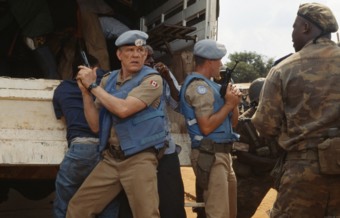
EURef recently reported on the latest in the attempts of Rwanda to come to terms with the genocide which took place over a decade ago, by blaming France.
Well, that could be all it is, but this report indicates some telling actions on the part of French troops, including how "French forces lured Tutsis from hideouts in the hills to village centers where they were killed."
That detail comes right at the end of the article, and one senses that, where the media have covered the latest allegations, scepticism has been built in to the reporting. The BBC's article, for example, takes a long time before moving to specifics.
What is not in doubt is that France trained the Hutu military which was active in the slaughter, up to the time of the slaughter (after it there was no need).
Beyond that, the problem is that there are strong political motives to blame France, exemplified here, and there is a history of false claims against (fmr) colonial powers such as this one where the Brits were accused of mass rape of Kenyan women.
The unequal battle and sometime absurdity of African claims against (fmr) colonial powers is comically evident in the understated BBC presentation:
"A forensic examination of police records in Kenya has concluded that all known reports of alleged rape by British army soldiers are forgeries.
This is a major development in the rape cases"
Er, what rape cases?
Still, despite this there is a moral responsibility I would like to highlight, and by that standard the French are well and truly guilty. The moral standards in Africa may be terribly schizophrenic, but if a sane person, for the sake of retaining and enhancing their status in society, facilitated and encouraged a temporarily insane and generally unstable person's desire to kill people, wouldn't they actually be morally guiltier than the mental person?
It may sound like a thin argument, but in the absence of reliable evidence there is much sense in saying that France was responsible for the genocide, an event of remarkable superfluity in Africa's grim trajectory.
The great film Hotel Rwanda begins with a radio broadcast indicating President Clinton's preoccupation with Bosnia, and later another broadcast describes the refusal of the State department to define events as "genocide"- a definition upon which intervention was contingent.
But the part which struck me most was the part where hero of the story, Rwandan hotel manager Paul Rusesabagina, calls his Sabena company boss in Belgium as a last throw of the dice when facing Hutu troops bent on emptying his hotel of its Tutsi refugees. The exchange went thus:
Sabena boss: "Who can I call to stop this?"
Rusesabagina: "The French, they supply the Hutu army".
Sabena boss: "I'll call you right back"
The Sabena boss (the film explains) contacts the French President's office. The hotel was spared. QED.
Heavy handed film maker's moralising for the audience, or a summary of action that took place?
The film is accurate and precise about British and US actions at the time, as well as UN and Belgian actions. I wouldn't bet against it over the French involvement. I never bought the army rape allegations from Kenya, though. Some things chime with their contexts, and the French involvemnt in Rwandan genocide is one of them. When you look at their behaviour in the Ivory Coast, a pattern of callousness seems to emerge quite alien from the British amnesia which tends to be our predominant vice.
Wednesday, October 25, 2006
Well, what d'you know? Sudan's about to annex Chad.
Despite media moral equivalence between Sudanese rebels and Sudan's military/militias, and despite moral equivalence between Sudan and Chad
- countries of wildly differing military strength- it was always blatantly obvious who the regional power was, and how aggressive (scroll half way down) were its intents.
We will live to regret not being tougher on Sudan. In the modern context occupation of territory is key (think how difficult it is for the US in Iraq when they occupy only dots on a map, or Israel when they try to take out Hezbullah), and the Islamists are getting plenty of that all across North and East Africa.
It's funny but I'm getting this pain in my back right where my White Man's Burden used to be.
Wednesday, April 26, 2006
The BBC's mudhut thread (not).
In 11 photos deemed by the BBC to represent African architecture, they were so keen to avoid the old stereotype about African buildings that the only photo of the typical dwelling -at least sub-sahara- the mud hut, was taken from inside, shot through a window. The limited view this gives is insufficient to get any idea of the classic staple dwelling of African life.
The twee PC narrowness of all this strikes me particularly forcibly since I was recently reunited with my large collection of Kenya photos, gained while living there seven years ago. I have mud huts galore, teeming compounds, ancient defensive structures, newly built churches, valleys gleaming with tin roofed huts. I also remember shiny clean smooth and cool concrete flooring, rafters in some buildings, raised maize barns; there was something of a genre but with more variations than you could express in words.
I wish I were in a position to download some photos, but here is an inferior example. However, I am sickened that the BBC is so narrow-minded as to think that showing the reality of African architecture in a more balanced way would be prejudicial against Africans. I don't really care if they would get complaints from Africans themselves, since the real African-in-nature so to speak would be unlikely to be among the complainants, while it is our BBC, and we deserve to know how others live. Architecture, I am sure many trendy enough architects would say, is about living spaces. The BBC have ignored the living spaces of Africans in favour of some political correctness. And that is typical.
Knowledge is key. I slept in many a mud hut and I loved many of them. Cool, calm, airy, sometimes even reasonably light. One has to bear in mind the warm temperatures and the hot, intense sun. Many was the time I sheltered beneath the drooping eaves of a mud hut. True, some were dirty, but most were not, and that's just as it is anywhere when it comes to interiors. Most were tidier than my current flat, anyway.
Monday, April 24, 2006
According to the BBC, Bin Laden's call for Holy War to Sudan and Hamas 'fell on deaf ears'.
The trouble is, do they need any hints from Osama? They seem to have the idea pretty well themselves.
The above link is to a story about violence spreading from Western Sudan. Although Chad itself is a majority Muslim country, that very situation tells me that it must be a moderate one- since there is a sizeable Christian minority and no civil war. And being moderate these days just isn't good enough for the A-list Jihadis. Additionally, it's been clear to me for some time what the Jihadi aim is in North Africa: obviously they want an Islamic caliphate stretching across Africa from Nigeria to Sudan, and extending South from there.
Wednesday, February 15, 2006
A Whim for Zim. (a post-valentine's message)
Over the course of a while, as I browsed my visitor stats (a sobering experience, believe me), I noticed an interesting pattern. I kept getting visits from some computer (or computers) lodged in a particularly forsaken nook of sub-saharan Africa. I mean Bob's country, the land of Rhodes, you get the picture?
Oh well, I rarely mentioned the country, despite having it on my heart really most of the time- just how do you deal with the devil's playground?
It's sad to say but when you read reports coming out of the country that's what you conclude: the 'vintage' one (I quote the BBC) has made it his business to flout the needs of his people, to hurt them, in the most bizarre, cruel and brazen ways. The more brazen he is the more he gets away with it. Don't tell me he's going to keel over and die. I don't believe it, although I can't say for sure, of course. He seems a healthy old goat.
So what to do, what to do? I could as well keep a record of Bob's evil acts as I could a record of sick jokes that I've heard.
I link almost at random this current instance; there have been many more. There can be no doubt that the repression in Zim is routine and sadistic.
I may have mentioned on this site that I spent some time- about six months- in East Africa a few years ago. I was fortunate and had no health problems; no typhus or bruscella, and no malaria, entered my blood-stream. Something about Africa did though, and I've been carrying it around ever since.
That something tells me that all we need to do is tell Mugabe 'no', to stand up to him in all the ways available and some that aren't immediately available. I'd favour an armed intervention and I'd bet all I have that just a small one would have miraculous effects, without anything like the Iraqi situation emerging. Not exactly a second Rhodes raid, but not far off in spirit, is what I have in mind.
Well, anyway, I don't seem to be getting the visitor from Zim anymore, so he or she won't get to read this, my small cry on behalf of a long-suffering people. But if there's one thing I'd like people everywhere to take on board about this it would be that it doesn't have to be this way.
Subscribe to:
Comment Feed (RSS)

